In This Issue
- Four years of CarbonDew: from an idea to expert members from 275+ organizations
- Our journey
- Direct flux measurements move from science into practice
- Top ten recent developments: direct flux measurements delivering societal benefits
- Community highlights since our last update (September 2024)
- Upcoming events
- How you can help
- Current funding opportunities
- Current career opportunities
- CarbonDew in pictures
Section 01
Four Years of CarbonDew
Section 02
Our Journey
We started CarbonDew in 2022 with a simple conviction: measurements of carbon, greenhouse gases, water vapor, and heat exchanged directly between land and air can anchor fair, transparent, and interoperable climate solutions. We did not set out to run another academic study, but to help move decades of flux-network science into practical use by growers, industry, cities, regulators, investors, and carbon and water markets.
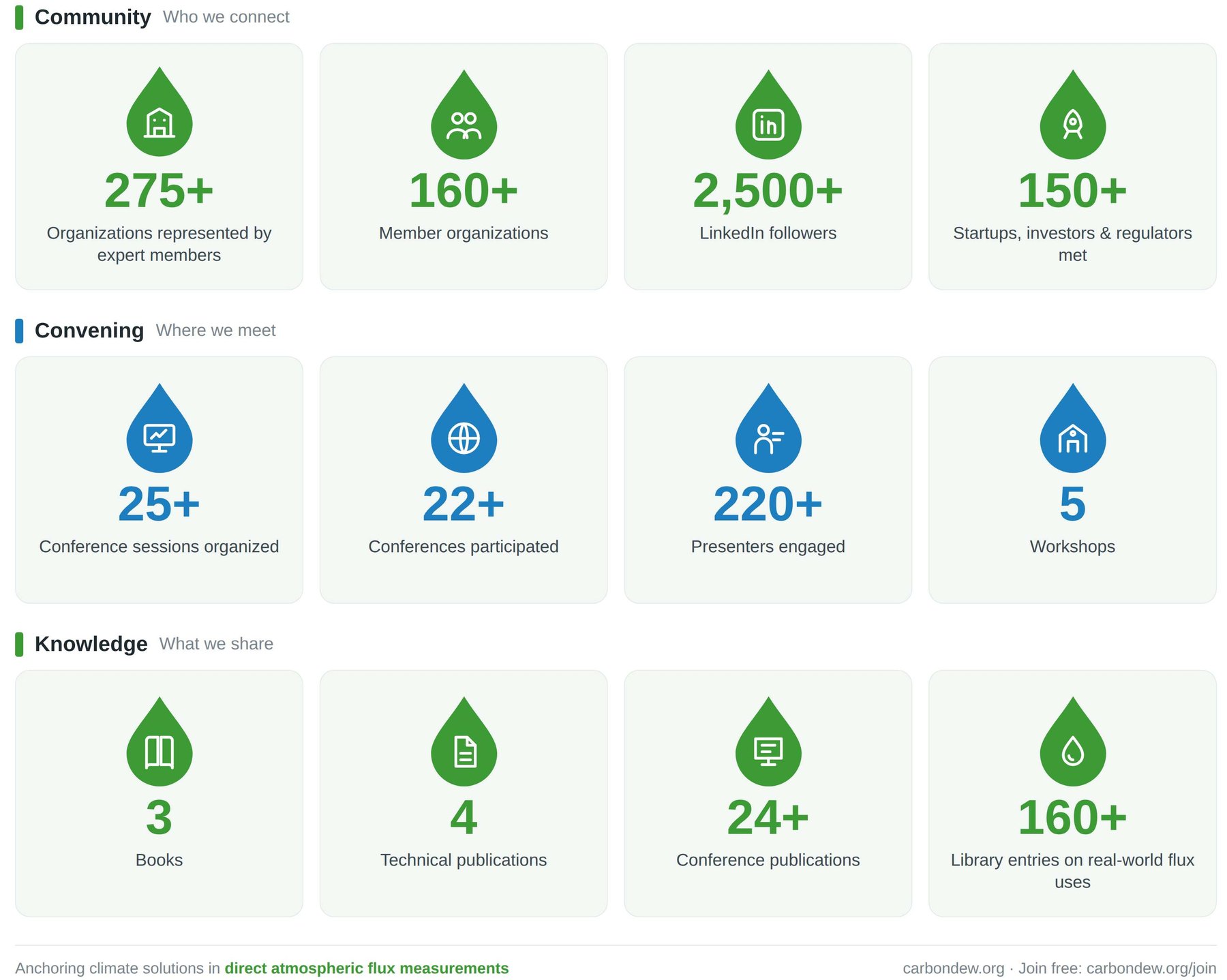
Today, the CarbonDew Community of Practice brings together expert members from more than 275 organizations and 160+ collaborating organizations, from directors of major government agencies and executives of global corporations to startups, investors, insurers, universities, and NGOs. Since our last update in September 2024, the community has grown by nearly 40%. Joining is still free and simple, and we still try hard not to flood your inbox.
Over four years, we have taken part in 22+ conferences and 5 workshops, organized 25+ conference sessions engaging 220+ presenters, authored and co-authored 3 books, 4 technical and 24+ conference papers, and met with more than 150 climate and carbon startups, investor groups, and regulators, including US Senate and House Offices. We co-hosted two flagship AmeriFlux-NEON-CarbonDew workshops, built a Library of real-world applications, started a Quarterly Talk Series, and carried the message about the importance of direct measurements from Vienna and Singapore to Capitol Hill.
Most importantly, the field itself has moved in a noticeable way, and we played a role! In 2022, direct flux measurements were rarely mentioned in carbon crediting. Since 2025, a flux-based crediting module has been available to carbon projects worldwide, a second registry methodology based on Net Ecosystem Exchange has gone through public consultation, a new corporate removals standard requires continuous monitoring, and cities, water agencies, and national programs are deploying flux towers to guide real decisions. The overall use of direct flux measurements for immediate societal benefits, well beyond carbon crediting, has also grown sharply (see Table 1 and the Top Ten Developments below).
Many of you made this happen, through your work, your advocacy, and many thoughtful discussions, often and mostly in private. There is definitely a way to resolve climate and carbon issues by working together across domains, sectors, and silos, and it is working, slowly but surely. Thank you for four remarkable years!
Milestones, 2022–2026
- 2026Scaling up
- AGU, San Francisco (Dec, upcoming); AsiaFlux, Bangkok (Nov, upcoming); ICOS Science Conference, Lund (Sep); AOGS, Fukuoka (Aug); EGU, Vienna (May); Remote Sensing & Fluxes Workshop, Boulder (Mar).
- 2025Recognition
- AGU, New Orleans (Dec); AsiaFlux, Riau (Oct); AGU Chapman Conference, Boulder (Sep); AOGS, Singapore (Jul-Aug); EGU, Vienna (Apr-May); SCD0003 goes live (Mar); Quarterly Talk launch (Mar); LI-COR Connect, Tucson (Feb); International Carbon Registry, Reykjavík (Jan).
- 2024Building bridges
- AGU, Washington DC, 40 presentations and Congressional visits (Dec); ICOS Science Conference, Versailles, 20 presentations (Sep); CarbonDew Library launched (Sep); AmeriFlux-NEON-CarbonDew Workshop, Berkeley (Jul); AOGS, Gangwon-do (Jun); EGU, Vienna (Apr); featured by Green Success Stories (Apr); AMS, Baltimore (Jan).
- 2023Finding our voice
- AGU, San Francisco (Dec); WMO Global Greenhouse Gas Watch Workshop, Geneva (Oct); AmeriFlux Annual Meeting, Gardner (Oct); coordinated response to the draft U.S. Federal Strategy for GHG Measurement in Agriculture and Forest Sectors (Aug); ESA, Portland (Aug); first CarbonDew newsletter (Jun); EGU, Vienna (Apr); coordinated response to the draft Federal Strategy for an Integrated U.S. GHG Monitoring and Information System (Apr); Battelle Conference, Columbus (Mar); NACP meeting, online (Feb); iLEAPS-OzFlux, Auckland (Jan).
- 2022Founding
- CarbonDew founded as a Community of Practice linking flux-measurement science with real-world users; ICOS Science Conference, Utrecht: “2100+ CO₂ and H₂O Flux Measurements Across the Globe: Sitting on a Golden Egg?”
Section 03
Direct Flux Measurements Move into Practice
Carbon Crediting and Standards
In March 2025, the Social Carbon Foundation and CarbonDew member Hyphen Global released SCD0003, the first open-source carbon crediting module that quantifies CO₂, CH₄, and N₂O reductions and removals from direct, continuous eddy covariance measurements rather than activity-based emission factors. After public consultation (January 29 - February 27, 2025), it went live on March 21, 2025, and is open to all carbon projects and MRV providers globally. And a new NEP-based protocol is in the works! In parallel, the International Carbon Registry developed M-ICR009, an atmospheric monitoring methodology based on Net Ecosystem Exchange that combines eddy covariance stations with 30-m satellite remote sensing; its public consultation ran January-February 2025, and it is on hold pending completion of validation.
CarbonDew members now also serve in standard-setting and advisory roles. In 2023, the community submitted coordinated responses to two draft U.S. federal greenhouse gas measurement and monitoring strategies. In December 2024, members visited U.S. Senate and House offices. And in 2026, a CarbonDew co-founder joined the Social Carbon Independent Standards Board.
Real-World Use Is Accelerating
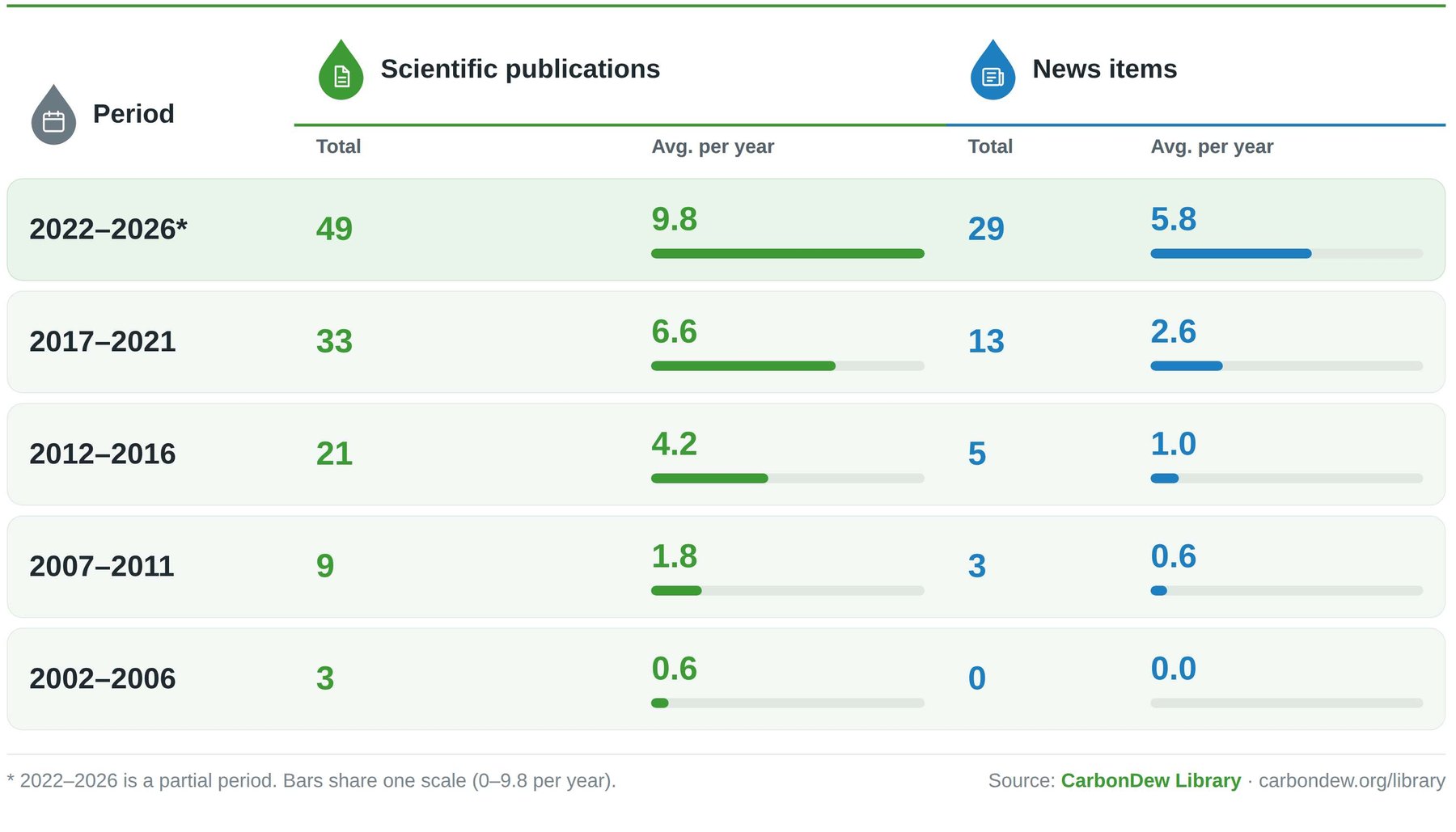
The use of direct flux measurements in real-world applications for immediate societal benefits has grown steadily for two decades and sharply since 2017. Scientific publications documenting such uses rose from about 0.6 per year in 2002-2006 to nearly 10 per year in 2022-2026, while related news coverage rose from none to almost 6 items per year (Table 1). Together, these form the 160+ entries now tracked by the CarbonDew Library.
Section 04
Top Ten Recent Developments: Flux Measurements at Work
Credible recent developments in which direct measurements of CO₂, CH₄, water vapor, or heat fluxes were used, or formally enabled, for immediate societal benefits:
- Measuring Colorado River evaporation directly (July 2026). DRI, OpenET, the Upper Colorado River Commission, and the Bureau of Reclamation are placing eddy covariance stations on floating platforms at Flaming Gorge, Blue Mesa, and Navajo reservoirs to verify evaporation for reservoir operations and water accounting.
- Open urban flux data for U.S. cities (February 2026). The INFLUX network released eddy covariance data from 11 locations in and around Indianapolis, a NIST urban greenhouse gas test bed, to help pinpoint where urban emissions occur.
- Corporate removals must be monitored continuously (January 2026). The GHG Protocol Land Sector and Removals Standard, effective January 2027, requires ongoing monitoring that can detect reversals of land-based removals, a role tailor-made for continuous flux measurements.
- Zurich verifies city emissions from the air (December 2025). The ICOS Cities project concluded that Zurich can track city-wide CO₂ emissions from atmospheric measurements, including direct eddy flux on a high-rise, to check progress toward net zero by 2040. Multi-species eddy covariance on a 112-m tower also attributed CO₂, CO, NOₓ, CH₄, and N₂O fluxes to traffic and heating.
- Ground-anchored ET for water managers nationwide (December 2025). OpenET, benchmarked against ground flux measurements, expanded to all 48 contiguous states; Reclamation and the four Upper Colorado Basin states adopted it as the basis for measuring irrigated consumptive use.
- Dutch peatland policy, quantified (August 2025). Combining 16 eddy covariance towers and 141 low-altitude flux flights, the national NOBV programme found that each 10 cm of drainage adds about 4.6 t CO₂ per hectare per year, informing where to raise water tables toward the 1 Mt CO₂ reduction target for 2030.
- Flux-based irrigation planning in the Alps (2025-2026). ARPA Valle d’Aosta and partners built a 12-site evapotranspiration network (500-3,100 m) of direct ET measurements to refine regional irrigation requirements with the Regional Agricultural Department.
- Ireland’s national flux network (2025-2026). Teagasc’s National Agricultural Soil Carbon Observatory is establishing 28 eddy covariance towers on grasslands, mineral soils, and peatlands to refine national inventory emission factors.
- Measured-carbon projects in the field (2025-2026). Hyphen Global’s deployments stream real-time eddy covariance GHG data from a ranchland carbon project (two flux towers), a ~19,000-ha Valdivian rainforest conservation project in Chile, and a NOAA calibration effort at Oak Ridge’s Chestnut Ridge tower. In Chilean Patagonia, Carbon Real pairs flux and LiDAR measurements with 25-year conservation easements to fund land protection.
- First eddy covariance-based carbon crediting module (March 2025). Social Carbon’s SCD0003 enables continuous, direct quantification of CO₂, CH₄, and N₂O fluxes for rice, peatland, mangrove, reforestation, regenerative land management, and conservation projects (see Impact above).
Section 05
Other Community Highlights Since Our Last Update
- September 15-17, 2026Lund, Sweden
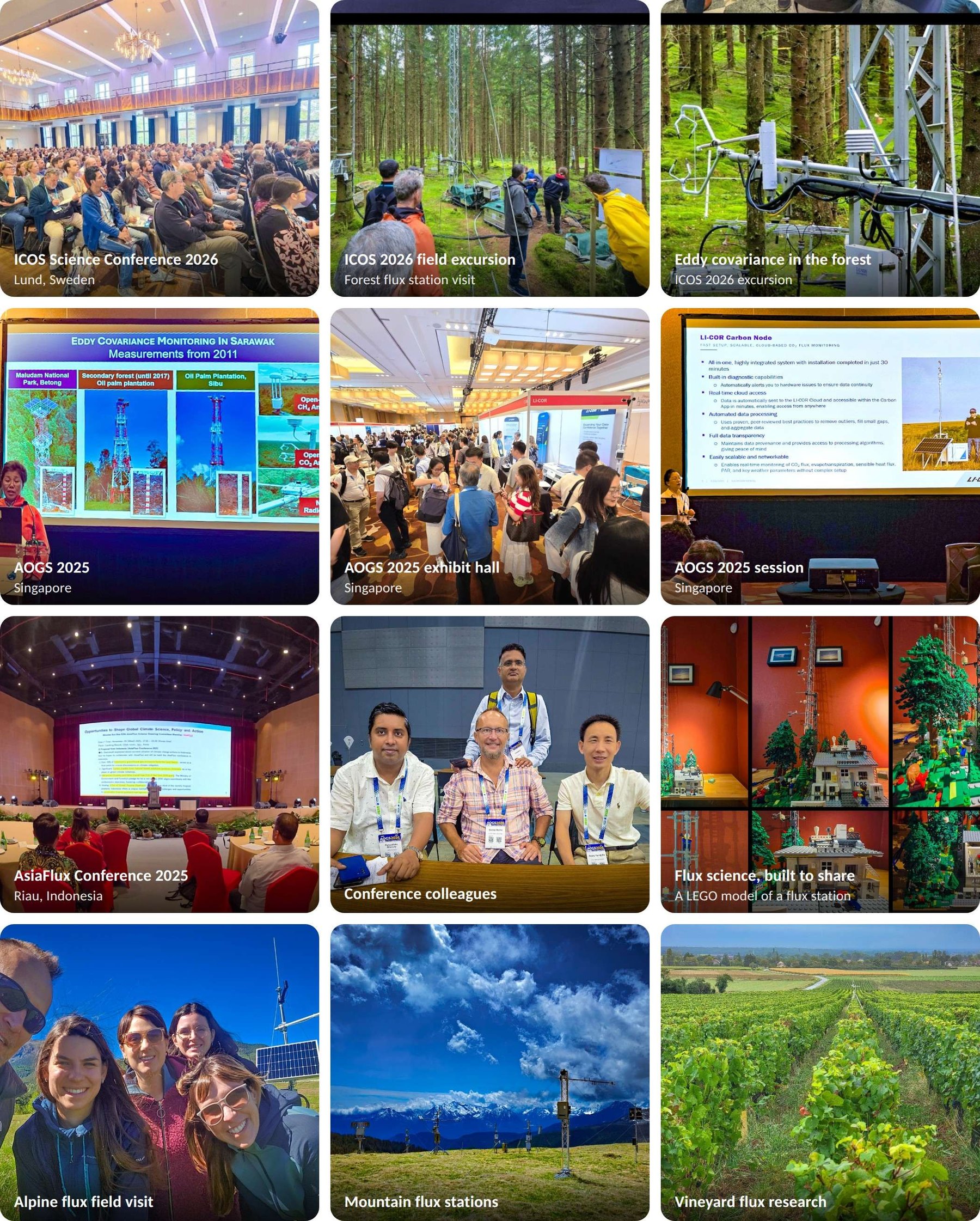
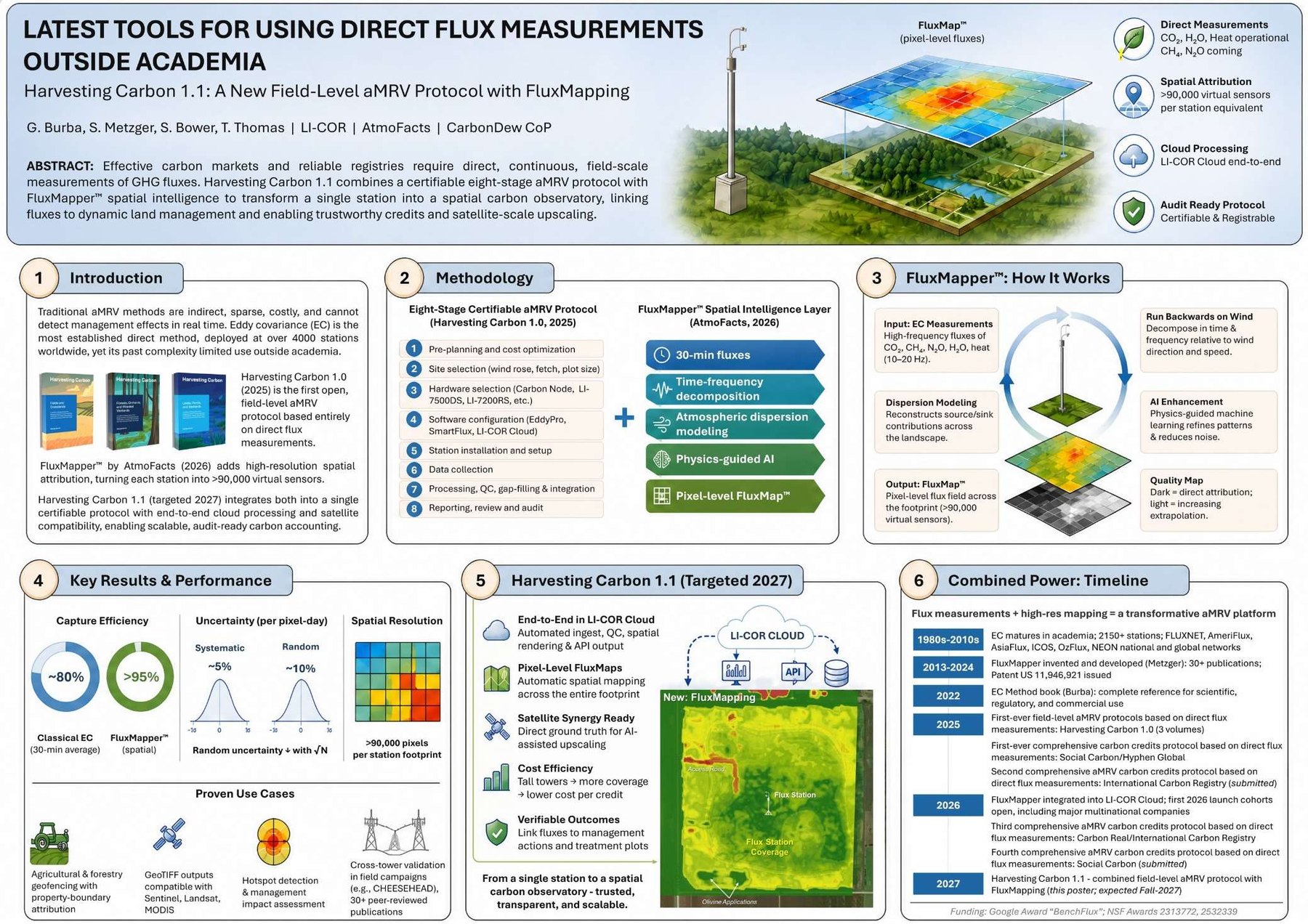
- ICOS Science Conference 2026Theme 31 “Flux measurements for immediate societal benefits” featured details on the new station-level protocol with FluxMapping; new tools for using flux measurements outside academia; and a framework for flux stations across Nigerian ecosystems.
- August 2026Fukuoka, Japan
- AOGS 2026Session BG05 “Direct Flux Measurements: from Science to Societal Benefits” was one of four sessions on environmental measurements for societal benefits; we also judged the Presentation Competition, and planning for AOGS-2027 is underway.
- May 4, 2026Vienna, Austria
- EGU General Assembly 2026Our societal-benefits session merged with the long-term flux networks session into BG8.3, co-sponsored by ICOS, with about 20 contributions spanning FLUXNET data harmonization, national networks in South Africa, product-carbon MRV, coal-mining emissions attribution, and solar-park CO₂ fluxes.
- March 4-5, 2026Boulder, Colorado
- Remote Sensing & Fluxes WorkshopThe second AmeriFlux-NEON-CarbonDew workshop brought researchers, early-career scientists, industry, regulators, and land managers together for hands-on work with cloud-based tools and reproducible workflows for ecosystem monitoring and carbon-market verification.
- December 15-19, 2025New Orleans, Louisiana
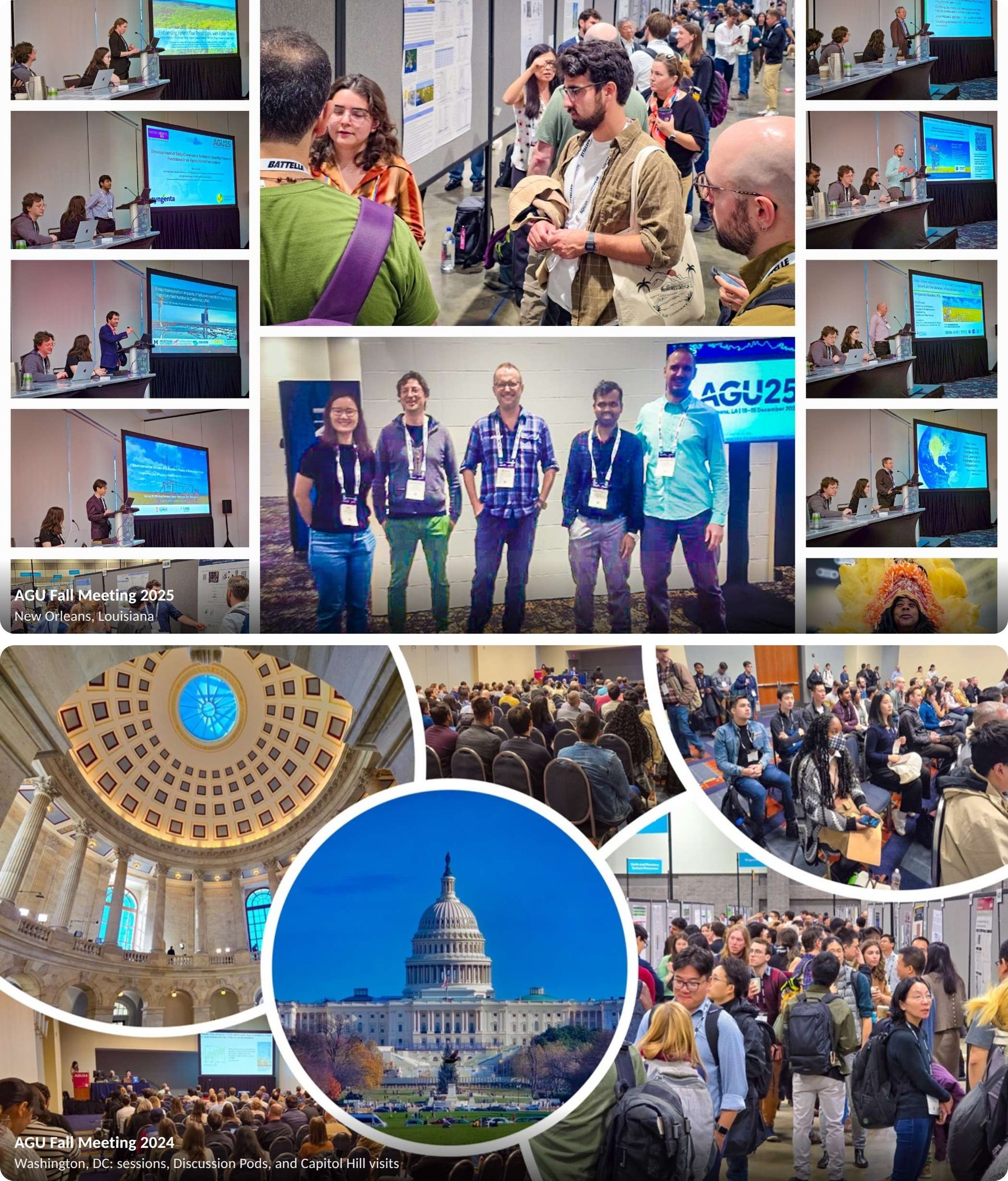
- AGU Fall Meeting 2025CarbonDew organized another session at the world’s largest gathering of Earth and space scientists, carrying forward the policy-facing momentum of AGU-2024.
- October 20-24, 2025Riau, Indonesia
- AsiaFlux Conference 2025Session “Direct Flux Measurements for Immediate Societal Benefits” in one of Southeast Asia’s most carbon-critical peatland regions.
- September 15-19, 2025Boulder, Colorado
- AGU Chapman Conference on EB ClosureTwo invited talks on energy balance closure, a core methodological challenge that directly affects the accuracy of flux measurements used for MRV.
- April 27 - May 2, 2025Vienna, Austria
- EGU General Assembly 2025Session BG8.8 “Flux Measurements for Immediate Societal Benefits” gathered 26 contributions.
- December 9-13, 2024Washington, DC
- AGU Fall Meeting 2024Oral and poster sessions “Surface-Atmosphere Interaction: Flux Measurements for Real-World Impact” drew 40 presentations, including Discussion Pods, and members visited U.S. Senate and House offices to explain how direct flux measurements can support credible, cost-effective climate and agricultural policy.
Section 06
Upcoming Events
- July 25-30, 2027Marina Bay Sands
- AOGS 2027 (Asia Oceania Geosciences Society) - SingaporeThe 24th annual meeting of the Asia Oceania Geosciences Society, the region's leading geosciences meeting. CarbonDew-related sessions ran at AOGS-2024 (Gangwon-do), AOGS-2025 (Singapore), and AOGS-2026 (Fukuoka), and planning for an AOGS-2027 session on direct flux measurements for societal benefits is underway. Abstract submission opens October 26, 2026; the abstract deadline is January 15, 2027. asiaoceania.org/AOGS2027
- April 4-9, 2027Austria Center Vienna and online
- EGU General Assembly 2027 (European Geosciences Union) - Vienna, AustriaEurope's largest geosciences meeting. CarbonDew-related flux sessions have run every year since 2023, most recently one co-sponsored by ICOS at EGU-2026. Details on CarbonDew-related sessions to follow. The call for abstracts opens October 28, 2026; support applications are due December 1, 2026, and abstracts January 12, 2027. egu27.eu
- December 7-11, 2026
- AGU Fall Meeting 2026 - San Francisco, CaliforniaThe world's largest Earth and space science meeting, with more than 24,000 attendees expected. CarbonDew sessions ran at AGU-2023 (San Francisco), AGU-2024 (Washington, DC; 40 presentations and Congressional office visits), and AGU-2025 (New Orleans), and a CarbonDew session has been accepted for AGU-2026. Details on CarbonDew-related sessions and meetups will follow soon by email. Late-breaking abstracts are due October 13, 2026; early registration ends November 5, 2026.
- November 23-28, 2026Kasetsart University
- AsiaFlux Conference 2026 - Bangkok, ThailandThe annual conference of the AsiaFlux network, themed "Advancing Carbon and Energy Flux Research for Climate Resilience and Carbon Neutrality in Asia." It marks Thailand's return as host after nearly two decades and the 20th anniversary of ThaiFlux. Following the CarbonDew session at AsiaFlux-2025 (Riau, Indonesia), Theme #9 "Direct Flux Measurements for Immediate Societal Benefits" has been accepted. Training courses run November 23-24, main sessions November 25-27, and field excursions November 28; early-bird registration ends October 10, 2026. asiaflux2026.com
How You Can Help – Write to founders@carbondew.org
1. Contribute to the Library. Share concrete examples of eddy covariance used for decisions, markets, or management.
2. Speak at a CD Talk. Showcase your organization’s work with direct flux measurements.
3. Co-organize a session. Help us convene at EGU-2027, AOGS-2027, ICOS, AsiaFlux, AGU, and regional meetings.
4. Publish with CarbonDew. Lead or co-lead a community paper, such as “The Power of Simplicity: Three Fresh Paradigms for Net-Zero Accountability.”
5. Invite a colleague. Joining is free at carbondew.org/join; the more sectors at the table, the faster solutions scale.
Section 07
Current Funding Opportunities
- Horizon Europe: land and ocean carbon sources and sinks (opens November 2026). Topic HORIZON-CL5-2027-01-D1-12 “Better understanding and attribution of land and ocean carbon sources and sinks”: EUR 25 million in total, up to EUR 5 million per project; deadline March 4, 2027.
- Frontier: open-system MRV toolkit (rolling). Frontier’s innovation program seeks better, lower-cost sensors, models, and reduced uncertainty in net-removal calculations for open-system carbon removal; R&D grants of about USD 250,000–750,000 and prepurchases of about USD 250,000–1.5 million; pre-applications accepted on a rolling basis.
- Water4All 2026: sustainable water management (pre-proposals due November 10, 2026). The Water4All Joint Transnational Call (about EUR 34 million) includes Topic 1, “Integrated Monitoring and Assessment for Sustainable Water Management”; full proposals due April 6, 2027.
- U.S. DOE Office of Science FY 2027 Open Call (through September 30, 2027). DE-FOA-0003665 covers Biological and Environmental Research among other programs (up to about USD 400 million across the Office of Science); pre-applications are required for some review panels.
- Horizon Europe: Agriculture of Data partnership (deadline November 26, 2026). Topic HORIZON-CL6-2026-04-GOVERNANCE-01, “Additional activities for the European Partnership of Agriculture of Data”: EUR 23 million for data-driven monitoring and decision support in agriculture.
- EIC Accelerator (full proposals due November 4, 2026). For start-ups and SMEs in the EU and associated countries scaling flux, sensing, or MRV technologies: up to EUR 2.5 million in grants plus EUR 1–10 million in equity; short proposals accepted at any time.
- ERC Consolidator Grants 2027 (deadline January 12, 2027). Up to EUR 2 million over five years for frontier research, with up to EUR 1 million more for major equipment and other justified costs.
- MSCA Doctoral Networks 2026 (deadline November 24, 2026). EUR 593 million for 130+ international doctoral training networks, a natural fit for multi-site flux-measurement and MRV training consortia.
- ERC Starting Grants 2027 (deadline October 14, 2026). Up to EUR 1.5 million over five years for researchers who defended their PhD between 2017 and 2026.
- U.S. NSF SBIR/STTR, including a scientific-instrumentation pilot (deadline November 4, 2026). NSF 26-510 and 26-511 fund deep-technology start-ups; the November 4 full-proposal deadline applies to teams with an invited Project Pitch.
Section 08
Current Career Opportunities
- Postdoctoral Scholar, Climate Legacies and the C Cycle, Northern Arizona University (apply by October 14, 2026). Quantify the legacy effects of extreme climate events on dryland carbon cycling, with the option to work with eddy covariance tower network data.
- Head of Climate and Agriculture Research Group, Agroscope, Zurich, Switzerland (starts January 1, 2027). Lead research on soils as a greenhouse gas source or sink and on emission-reduction options, with responsibility for the Swiss Agricultural Greenhouse Gas Inventory.
- Postdoctoral Associate, Warming-Induced Emissions, Yale Center for Natural Carbon Capture (open until filled). Research on greenhouse gas emissions triggered by warming, New Haven, Connecticut.
- Postdoctoral Fellows, Yale Center for Natural Carbon Capture (apply by December 1, 2026). Fellowships on natural carbon capture science, New Haven, Connecticut.
- Senior Machine Learning Engineer, Carbon Mapper (remote, U.S.; open). Build models and data-quality tools for methane and CO₂ emission data products from remote sensing.
- Geospatial Data Analyst (contract), Isometric, London (posted September 21, 2026). Join a carbon removal registry that certifies removals with measurement-based protocols.
- Two PhD positions in biosphere–atmosphere carbon cycling, University of Georgia (interest form by November 15; apply by December 1, 2026). Wu Sun lab, Odum School of Ecology, Athens, Georgia.
- PhD position, Vegetation, Soil Microbes, and Carbon Cycling Across Scales, University of Amsterdam (deadline October 18, 2026). Institute for Biodiversity and Ecosystem Dynamics, the Netherlands.
- UCAR Climate & Global Change Postdoctoral Program (apply by October 16, 2026). Two-year fellowships hosted at U.S. institutions of the fellow’s choice.
- Assistant or Associate Professor of Ecosystem Ecology, University of Alaska Fairbanks (review begins November 9, 2026). Boreal ecosystem ecology faculty position, Fairbanks, Alaska.
Know of others? Send them to founders@carbondew.org.
Section 10
CarbonDew in Pictures
Snapshots from CarbonDew sessions, workshops, and field visits, along with our latest poster for AGU-2026.
Join CarbonDew: carbondew.org/join | Contact: founders@carbondew.org | LinkedIn: linkedin.com/company/carbondew
CarbonDew™ Community of Practice